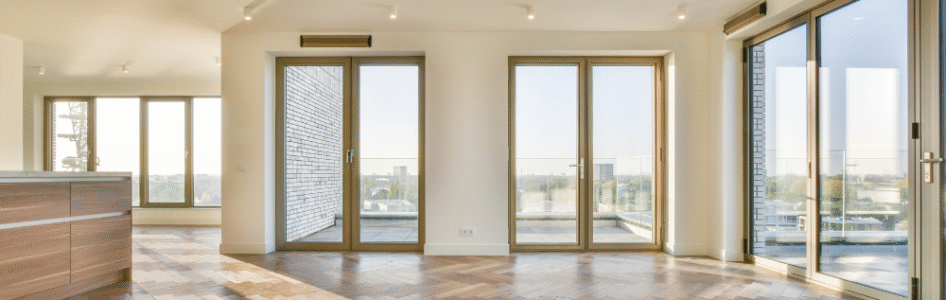
Modern construction places increasingly higher demands on the thermal insulation of the materials used, especially window and door joinery. Aluminum joinery, formerly associated mainly with low thermal insulation, is becoming a material that meets the requirements of passive and energy-efficient houses thanks to technological progress. The article discusses the properties of aluminum, modern technologies that increase its thermal parameters, and the installation of aluminum joinery. Arguments were also presented for the use of aluminum in energy-saving construction investments.
- Introduction
In the era of global climate change and rising energy prices, the energy efficiency of buildings is a key topic. The Polish construction sector dynamically implements standards and standards that force a reduction in energy consumption for heating and cooling [1]. Energy-saving and passive buildings are solutions that minimize heat losses thanks to the use of properly designed and constructed external partitions, including window and door joinery [2].
Windows and doors are traditionally the weakest insulating point of the building, accounting for up to 30% of heat losses [2]. Choosing the right joinery is therefore fundamental to obtaining the declared energy parameters. In this context, aluminum, as a material with high thermal conductivity, requires the use of advanced design and technological solutions to meet these requirements [3].
2. Aluminum as a building joinery material
Aluminum is a metal with many unique physical properties that make it an attractive material for the production of window and door joinery. Its lightness – density of approximately 2.7 g/cm³ – allows you to create lightweight structures that are both very durable and resistant to deformation [4]. Corrosion and weather resistance allows for long-term use without the need for frequent maintenance, which is an important argument for investors [4].
The problem with aluminum is its high thermal conductivity, which in its pure form is about 210 W/(m K), much higher than that of wood or PVC [5]. Without appropriate design solutions, aluminum frames would cause significant heat loss and moisture condensation. Therefore, modern aluminum profiles are equipped with the so-called thermal spacers made of low-conductivity plastics, which divide the frame into two parts, minimizing thermal bridges [5].
Thanks to these technologies, aluminum gains a second life as a material for energy-saving joinery. The possibility of implementing large glazing and slim construction also affect the aesthetics and comfort of use of buildings [5].
- Thermal parameters of aluminum joinery
The heat transfer coefficient U is the basic measure for assessing the thermal insulation of windows and doors. For aluminum frames without thermal breaks, the U value may exceed up to 5 W/(m² K), which is unacceptable in energy-saving construction [6]. Thanks to the use of thermal spacers and high-performance glass packages, it is possible to lower this indicator to a level below 1.0 W/(m² K), and in the case of passive systems even to 0.6 W/(m² K) or less [6].
For comparison, modern wooden or PVC windows have a U-factor of 0.8–1.0 W/(m²·K). Aluminum joinery combined with low-emission glass packages and krypton gas or argon is therefore a real alternative also in terms of thermal insulation [6].
Another important parameter is the heat transfer coefficient of the entire window (Uw), which includes the frame, glass and the connection point to the wall. It determines the final energy efficiency of joinery in real conditions [6].
- Modern technologies in aluminum joinery
4.1 Thermal spacers and their role
Thermal spacers are a key element of modern aluminum joinery, significantly improving its insulating properties. They are made of materials with low thermal conductivity, such as glass fiber reinforced polyamide (PA6 GF30), whose thermal conductivity is approximately 0.28 W/(m K) [7]. Placed inside aluminum profiles, these spacers separate the inner part of the frame from the outer one, effectively interrupting the continuity of the metal and minimizing thermal bridges [8].
The use of thermal spacers not only reduces heat loss, but also prevents moisture condensation on internal surfaces, which is important for comfort of use and durability of the structure. An example of an innovative solution are split thermal breaks in Yawal systems, which eliminate the bimetal effect, preventing deformation of aluminum profiles under the influence of temperature differences [9].
Modern aluminum joinery systems, such as the MB-86N from Aluprof, are equipped with wide thermal spacers with a new shape, significantly improving thermal insulation. Additionally, the two-component central seal perfectly seals and thermally insulates the space between the leaf and the frame [10]
4.2 Szyby zespolone niskoemisyjne
W nowoczesnych oknach energooszczędnych standardem są szyby zespolone z powłokami niskoemisyjnymi (Low-E). Powłoki te, wykonane z cienkich warstw tlenków metali, odbijają promieniowanie podczerwone, zatrzymując ciepło wewnątrz budynku, jednocześnie przepuszczając światło widzialne.
Dodatkowo, przestrzeń między szybami wypełniana jest gazami szlachetnymi, takimi jak argon czy krypton. Argon, będący tańszym rozwiązaniem, obniża współczynnik przenikania ciepła U o około 17%, natomiast krypton, choć droższy, redukuje ten współczynnik nawet o 25% w porównaniu do powietrza [11].
W przypadku budynków pasywnych stosuje się pakiety szybowe składające się z trzech lub nawet czterech tafli szkła, co pozwala na osiągnięcie bardzo niskich wartości współczynnika U szyby (Ug), rzędu 0,4–0,5 W/(m²·K) [12][13].
4.2 Low-emission insulating glass
In modern energy-saving windows, insulating glass with low-emission coatings (Low-E) is standard. These coatings, made of thin layers of metal oxides, reflect infrared radiation, retaining heat inside the building while transmitting visible light.
Additionally, the space between the panes is filled with noble gases such as argon or krypton. Argon, which is a cheaper solution, reduces the heat transfer coefficient U by approximately 17%, while krypton, although more expensive, reduces this coefficient by up to 25% compared to air [11].
In the case of passive buildings, shaft packages consisting of three or even four glass panes are used, which allows achieving very low values of the U coefficient of the glass (Ug), of the order of 0.4–0.5 W/(m² K) [12] [13].
4.3 Warm installation – elimination of thermal bridges
Warm installation is one of the most important stages of window and door installation, which determines the final energy efficiency of the entire system. Its main goal is to maximize the reduction of thermal bridges at the interface between the frame and the wall, which in traditional installation may be responsible for up to 15–20% of heat losses [14].
In warm assembly, comprehensive solutions are used, such as vapor permeable tapes with adjustable vapor permeability, which prevent moisture from penetrating the structure while allowing water vapor to be discharged outside. In addition, special polyurethane foams with a low thermal conductivity coefficient and durable elastomeric sealants are used, which fill the mounting gaps and eliminate cold zones favoring condensation [14].
Assembly errors, such as improper filling of gaps or lack of appropriate seals, are one of the main reasons for reducing the thermal insulation of joinery and the formation of mold and moisture [15].
4.4 Intelligent solutions and automation
In modern energy-saving construction, automatic window and roller shutter adjustment systems are increasingly used, which improve user comfort and optimize energy consumption. Controlling ventilation through tilting windows or changing the permeability of glass using photochromic coatings are examples of technologies supporting energy efficiency. Integration of aluminum joinery with smart home systems allows for easy management of these functions and increases the comfort of everyday use of buildings [16].
- Aluminum joinery and building energy efficiency
Modern aluminum joinery, thanks to the use of modern technologies, plays a key role in improving the energy efficiency of buildings. Thanks to innovative solutions such as thermal breaks, triple glazing or seals with low thermal conductivity, aluminum windows achieve heat transfer coefficients (Uw) below 0.8 W/m² K, which makes them suitable even for passive houses. Additionally, aluminum allows the implementation of large glazing, which increases interior lighting and improves comfort of use, as well as has a positive effect on the microclimate and health of residents. In terms of durability and resistance to external conditions, aluminum exceeds other materials, which translates into lower operating costs and greater service life of joinery [17].
6. The future of aluminum joinery in energy-saving construction
Aluminum joinery in energy-efficient construction is undergoing a dynamic transformation, driven by technological innovation and growing environmental awareness. Modern materials, such as composites with high insulation or photocatalytic coatings, significantly improve the energy parameters of joinery, while increasing its durability and aesthetics. Integration with BMS (Building Management Systems) systems and the development of smart glass technology allow for dynamic regulation of heat and light transmittance, which translates into optimization of energy consumption and improved user comfort [18].
Additionally, legislative changes and growing ecological awareness of investors will drive the development and implementation of solutions with the highest insulation parameters and long service life. Aluminum joinery of the future will combine advanced technologies with ecological responsibility, consistent with the ideas of sustainable construction. Sustainable construction is an approach that seeks to minimize negative environmental impacts through efficient use of resources, reducing greenhouse gas emissions and using environmentally friendly materials [19].
Summary
Modern energy-saving and passive construction requires the use of joinery with very high insulating parameters. Aluminum joinery, thanks to modern technologies such as thermal breaks, low-emission insulating glass and precise, warm installation, has become a competitive material in terms of energy efficiency. Thanks to this, it is possible to significantly reduce heat losses, which translates into lower operating costs of buildings. Additionally, aluminum joinery enables the implementation of large glazing, improving the comfort and aesthetics of interiors. Modern intelligent automation systems and integration with smart home solutions support further optimization of energy consumption. The future of aluminum joinery is associated with the further development of materials and technologies, as well as the growing ecological awareness of investors, which fits into the idea of sustainable construction.
Bibliography:
[1] Ministry of Development and Technology. Energy efficiency of buildings. Gov.pl.
https://www.gov.pl/web/rozwoj-technologia/efektywnosci-energetycznej-budynkow
[2] Designer Primer. The most important principles of designing energy-efficient houses.
https://elementarzprojektanta.pl/najwazniejsze-zasady-projektowania-domow-energooszczednych
[3] Murator. Energy-saving windows – what is worth knowing. Murator Monthly.
https://miesiecznik.murator.pl/budowa/okna-energooszczedne_4626.html
[4] Murator. Energy-saving windows – what is worth knowing. Murator Monthly.
https://miesiecznik.murator.pl/budowa/okna-energooszczedne_4626.html
[5] Aluprof. Warm aluminum profiles – overview of technology and technical parameters.
https://aluprof.eu/pl/produkty/systemy-okienno-drzwiowe
[6] Muratordom.pl. Energy-saving aluminum windows – are aluminum windows warm?
https://muratordom.pl/budowa/okna/okna-aluminiowe-energooszczedne-czy-okna-aluminiowe-sa-cieple-aa-mmjp-aysB-ZL3X.html
[7] PolyamidePA6.pl. Polyamide with glass fiber PA6 + GF 30.
https://poliamidpa6.pl/poliamid-z-wloknem-szklanym-pa6-gf-30/
[8] Skrawplast. Polyamide thermal spacers with fiberglass.
https://skrawplast.pl/przekladki-termiczne-z-poliamidu-z-wloknem-szklanym/
[9] Yawal SA New, split thermal breaks that eliminate the bimetal effect!
https://www.yawal.com/nowe-dzielone-przekladki-termiczne-eliminujace-efekt-bimetalu.html
[10] Aluprof SA MB-86N Window and door system with thermal insulation.
https://aluprof.eu/producenci/oferta/systemy-okienno-drzwiowe/mb-86n-system-okienno-drzwiowy-z-izolacja-termiczna
[11] PRESS GLASS. Noble gases and thermal insulation in windows.
https://www.pressglass.com/pl/gazy-szlachetne-i-izolacja-termiczna-w-oknach/
[12] World of Glass. Emissivity and low-emission coated glasses. Part 3: Applications.
https://swiat-szkla.pl/article/8167-emisyjnosc-a-szkla-powlekane-niskoemisyjne-czesc-3-zastosowania
[13] World of Glass. Shaping the heat transfer coefficient in insulating glass.
https://swiat-szkla.pl/article/1996-ksztaltowanie-wspolczynnika-przenikania-ciepla-w-szybach-zespolonych
[14] World of Glass. Materials used in warm window installation.
https://swiat-szkla.pl/article/13396-materiay-stosowane-w-ciepym-montau-okien
[15] Czechowicz, M. Errors when installing – windows how to avoid? The 10 most common mistakes. Murator.pl.
https://muratordom.pl/budowa/okna/bledy-przy-montazu-okien-jak-uniknac-10-najczestszych-bledow-aa-7aPx-FASK-RqWL.html
[16] Smart Construction. Window and ventilation automation in modern homes.
https://budownictwosmart.pl/automatyka-okien-wentylacji/
[17] YAWAL SA Energy-saving aluminum windows. Which windows should you choose for a passive house?
https://www.yawal.com/energooszczedne-okna-z-aluminium-jakie-okna-wybrac-do-domu-pasywnego.html
[18] The Future of Glass: Energy-Efficient Innovations in Curtain Wall Systems. WellDone Inc.
https://www.welldoneinc.ca/energy-efficient-curtain-walls/
[19] Sustainable construction – selected aspects. Izolacje.com.pl.
https://www.izolacje.com.pl/artykul/ekologia-w-budownictwie/278039%2Cbudownictwo-zrownowazone-wybrane-aspekty